Privacy Education for K-12 Students
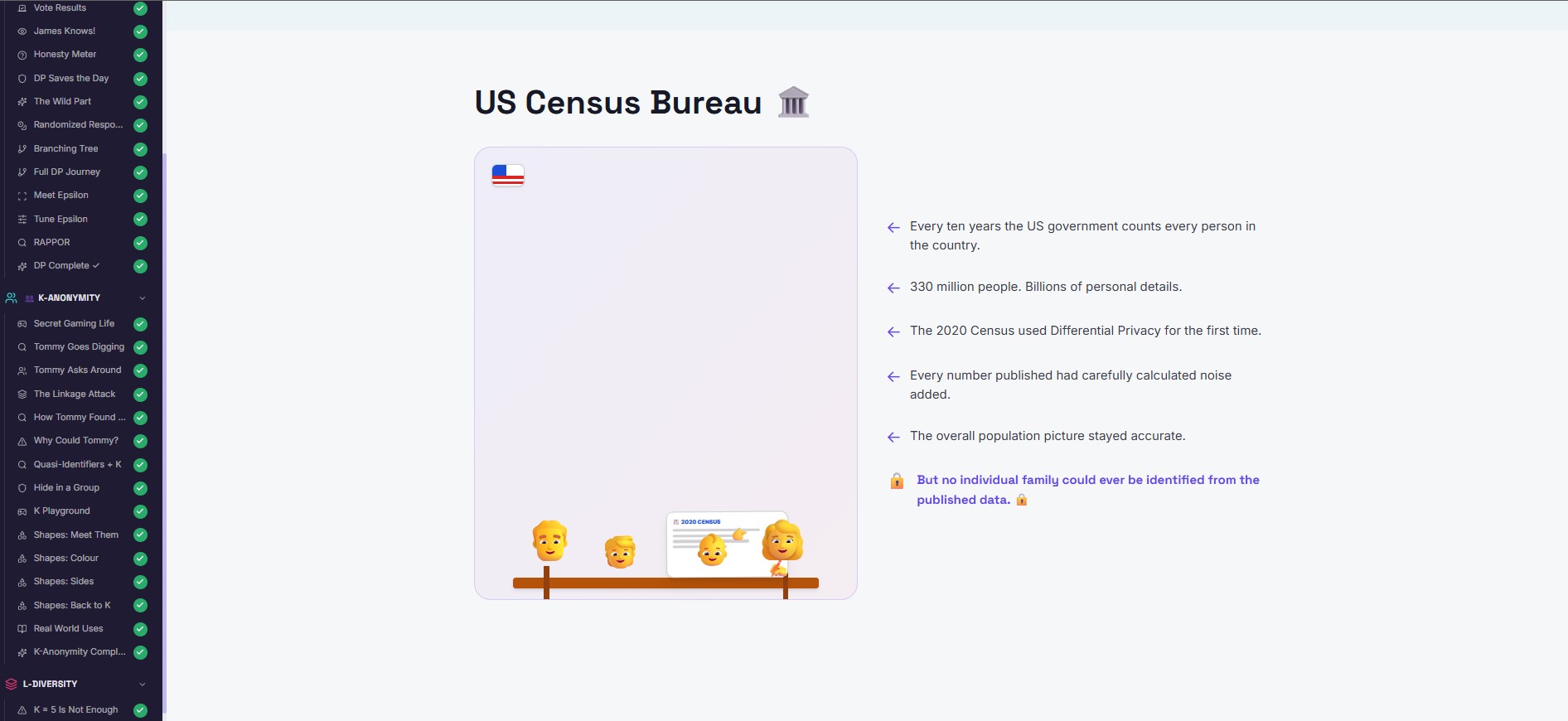 Children join online games and social platforms at very young ages, but they learn almost nothing about how their data can be linked together to identify them. Privacy techniques like differential privacy and k-anonymity already protect data at Apple, Google, and the US Census Bureau, yet these concepts are only taught at the university level. To fill this gap, we developed PrivacyPlay: an interactive scrollytelling web application that teaches privacy attacks and three foundational defense mechanisms — differential privacy, k-anonymity, and l-diversity — to middle school students using character-driven stories and interactive visualizations.
Modules
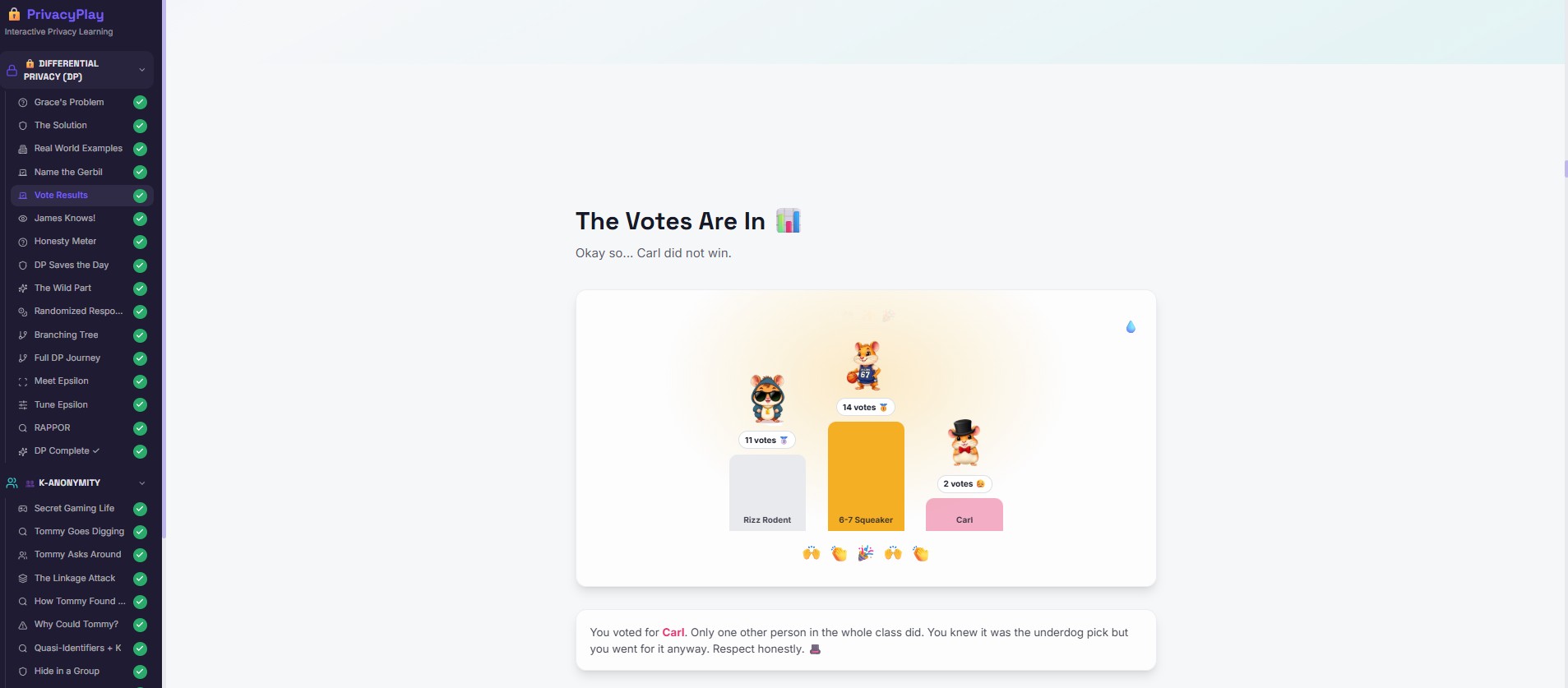 Part 1 — Local Differential Privacy through Randomized Response. Students are introduced to differential privacy through a classroom voting scenario: a student wants to vote for an unpopular pet name without being judged. The solution — flipping a coin to decide whether to answer truthfully — illustrates how randomized response works. An interactive slider then lets students adjust the noise level (epsilon) and observe how it affects the accuracy of results over a simulated dataset of one million votes, making the privacy-utility tradeoff tangible without any math background.
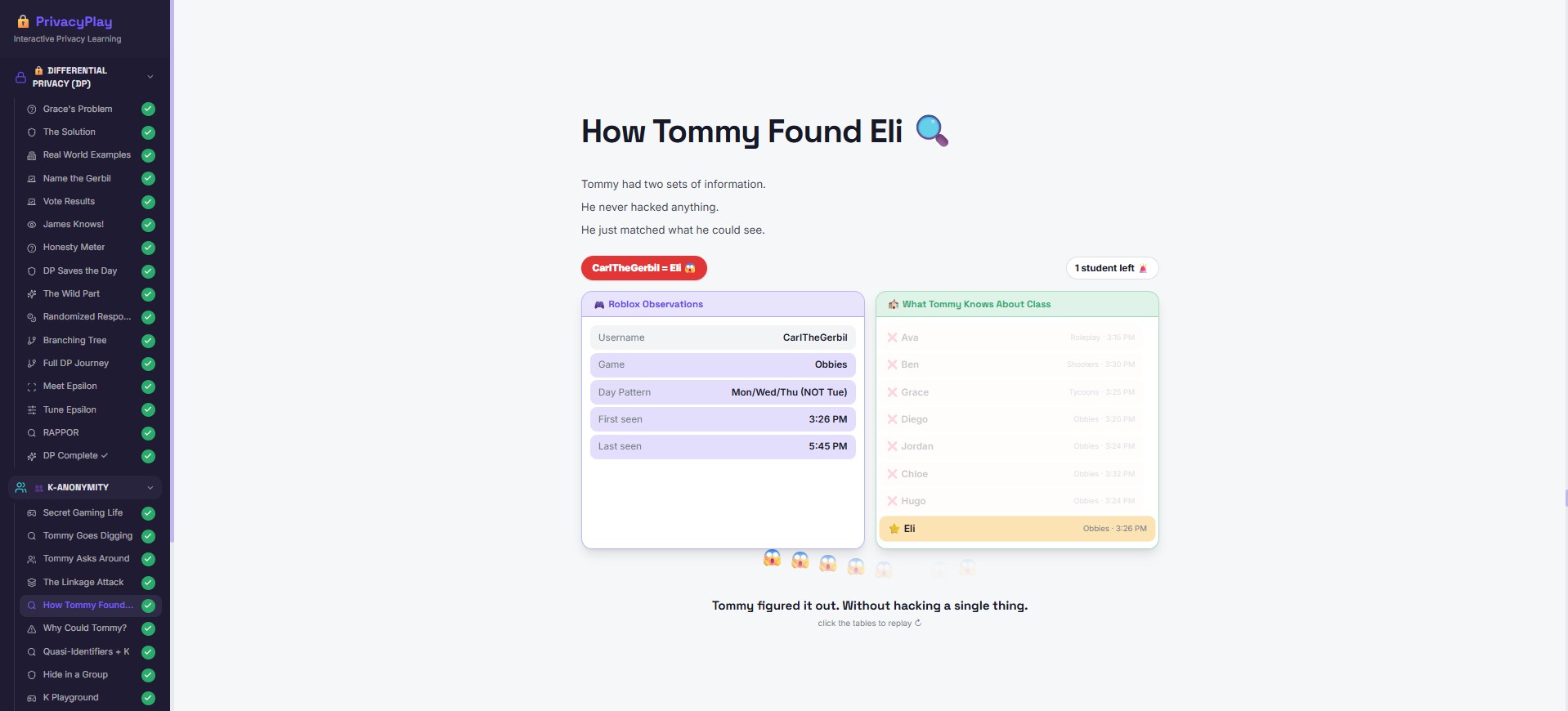 Part 2 — K-Anonymity through a Linkage Attack. Students follow a story where a classmate named Tommy unmasks a Roblox player named Eli — without any hacking — simply by cross-referencing publicly available information like login times and weekly schedules. A step-by-step visualization shows how four seemingly harmless data points narrow the list down to one person. K-anonymity is then introduced as the solution: the app shows how generalizing exact login times into broad time blocks makes it impossible to single out any one student.
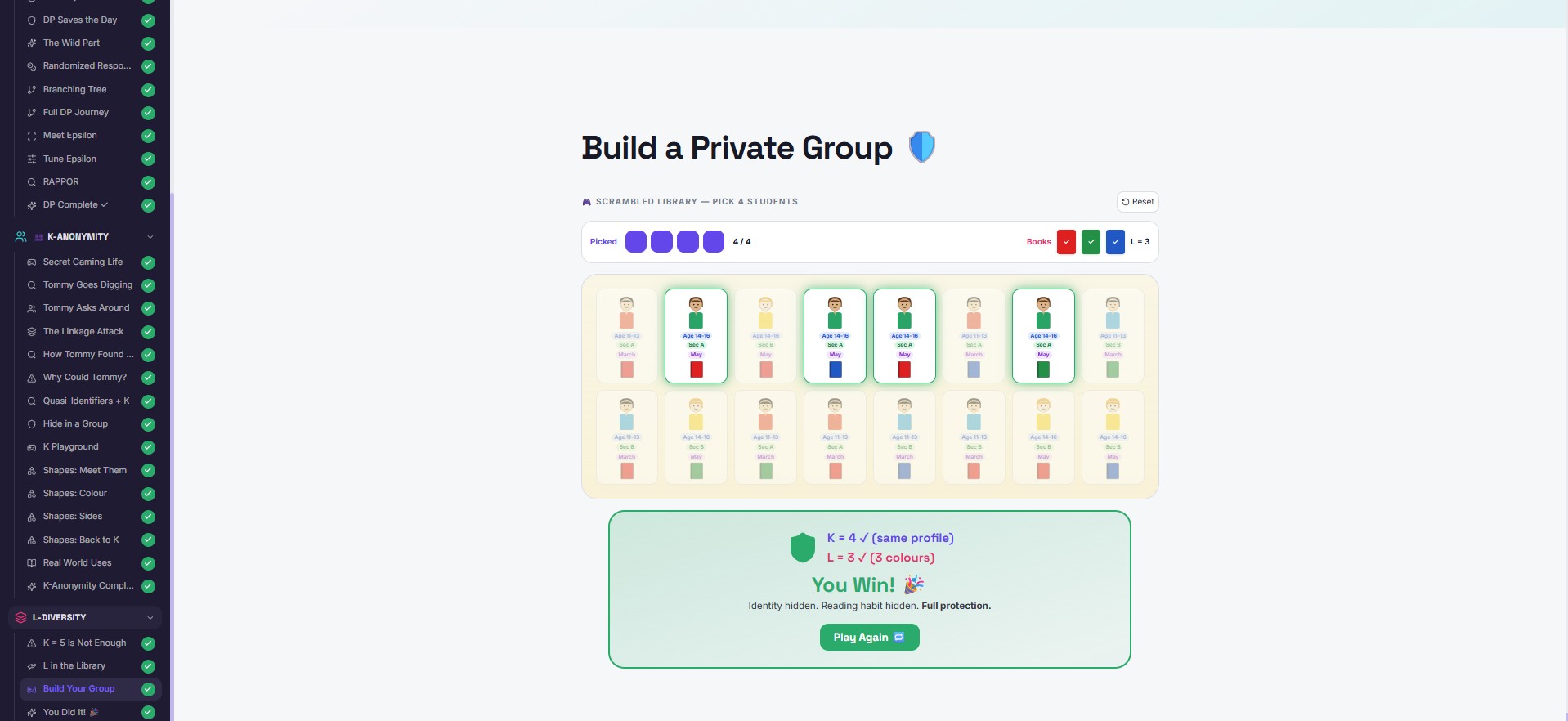 Part 3 — L-Diversity through a Grouping Game. Students learn that k-anonymity alone is not enough — if everyone in a group shares the same sensitive value, a person can still be identified. In a hands-on library game, students click on records to form groups that satisfy both k-anonymity (at least 4 people with the same general profile) and l-diversity (at least 3 different book titles per group). The app evaluates each attempt instantly, teaching students the failure modes of k-anonymity and how l-diversity addresses them.
Formative Study with 32 Middle School Students
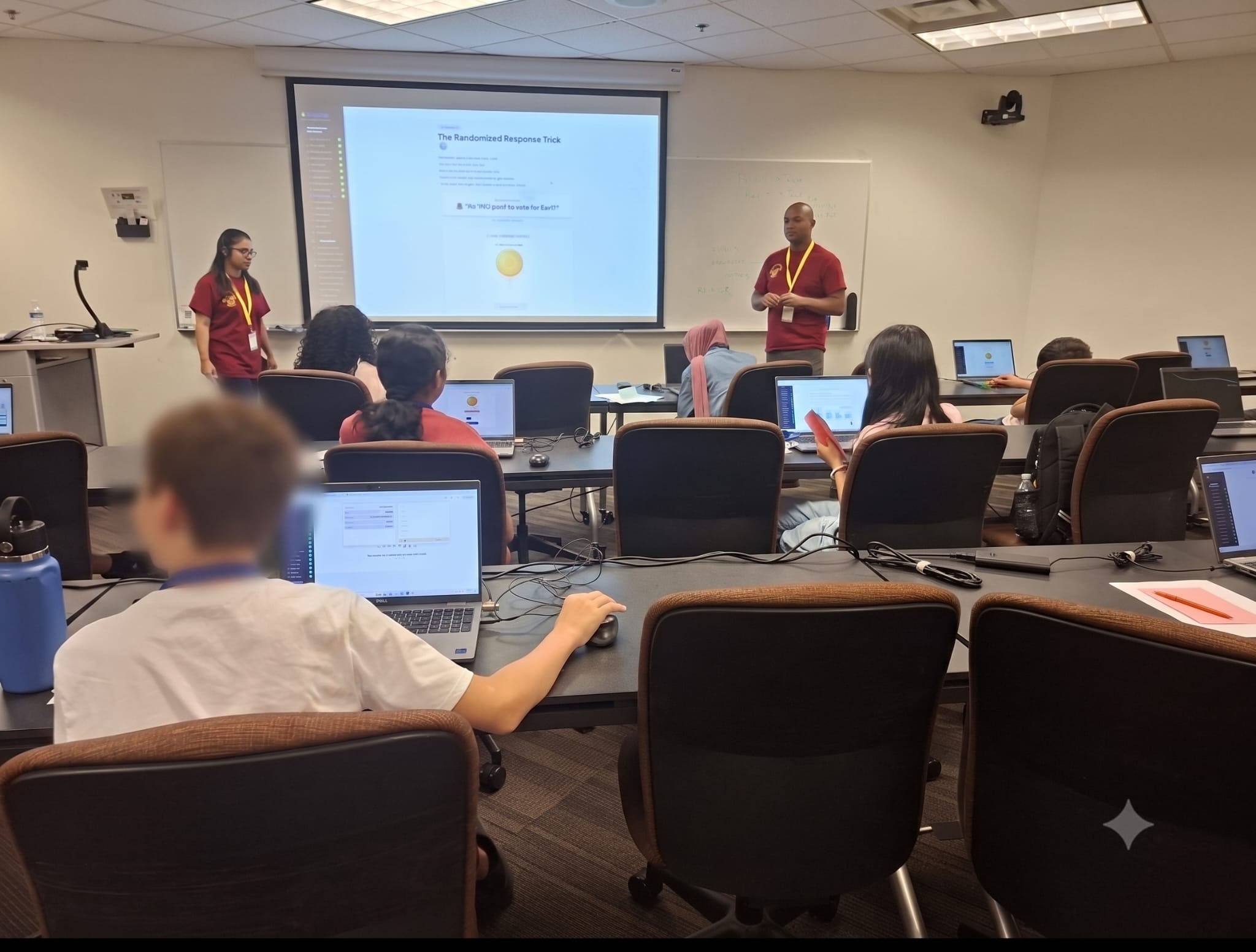 We conducted a formative study during a one-day computing outreach workshop at our institution. Thirty-two middle school students completed a 75-minute session with PrivacyPlay, followed by a survey with Likert-scale and open-ended questions. We did not test technical knowledge — instead, we focused on privacy risk awareness and curiosity. Results showed that 24 of 32 students recalled specific mechanisms by name, and 13 students described being surprised that privacy attacks do not require hacking. Students found the k-anonymity and l-diversity activities most engaging, with several able to explain the concepts in their own words. However, students struggled to understand how noisy data can still support accurate conclusions, pointing to a need for more walk-through examples of the privacy-utility tradeoff. Most students saw privacy as socially important but did not connect it to their own career interests — a gap we plan to address in the next iteration by showing how privacy mechanisms are implemented by regular software developers.
Methods: interactive system development, scrollytelling visualization design, user studies, surveys, qualitative thematic analysis.